ESL in Canada

ESL "English as a Second Language" in Canada education news about English schools, classes, lessons, study-tips, student visas, homestays, travel tips, student jobs, student prices. English test lessons for TOEFL, TOEIC, IELTS, CELPIP, Cambridge CFA CPC CAE FCA, GMAT, GRE, SAT, LSAT, DSAT, CAEL, Cantest, college board, IH, AP, TSE, YLE, BULATS, ILEC, and Michigan exams. ESL English lessons for work, school, jobs, travel, immigration, university admission, graduate studies, career training.

Friday, December 05, 2025

Canada's 2026 International Student Cap By Province

During 2026 the IRCC expects to issue up to 408,000 study permits, including 155,000 to newly arriving international students, as outlined in the 2026–2028 Immigration Levels Plan, and 253,000 extensions for current and returning students. 

As of January 1, 2026, master’s and doctoral level students enrolled at a public designated learning institution (DLI) will not need to submit a provincial or territorial attestation letter (PAL/TAL) with their study permit application. 

This exemption is in recognition of their unique contributions to Canada’s economic growth and innovation, and will support our efforts to attract talent.

The following groups are exempt from the PAL/TAL requirement in 2026:master’s and doctoral degree students enrolled at public DLIs
 
primary and secondary (kindergarten to grade 12) students
certain Government of Canada priority groups and vulnerable cohorts
existing study permit holders applying for an extension at the same DLI and at the same level of study.

The number of study permits expected to be issued in 2026, broken down by student cohort, is as follows:

2026 national target (new arrivals and in-Canada extensions)

Master’s and doctoral students enrolling at public DLIs (PAL/TAL-exempt)

49,000

Primary and secondary school (kindergarten to grade 12) students (PAL/TAL-exempt)

115,000

Other PAL/TAL-exempt study permit applicants

64,000

PAL/TAL-required applicants

180,000

Total

408,000

In 2026, up to 180,000 study permits are expected to be issued to applicants who require a PAL/TAL. The target of 180,000 is distributed to provinces and territories based on their population.

Province or territory

2026 study permit target for PAL/TAL-required cohorts

Alberta

21,582

British Columbia

24,786

Manitoba

6,534

New Brunswick

3,726

Newfoundland and Labrador

2,358

Northwest Territories

198

Nova Scotia

4,680

Nunavut

180

Ontario

70,074

Prince Edward Island

774

Quebec

39,474

Saskatchewan

5,436

Yukon

198

Total

180,000

The following allocations have been assigned based on each jurisdiction’s average study permit application approval rate from 2024 and 2025:

Province or territory

2026 allocations for all PAL/TAL-required applications

Alberta

32,271

British Columbia

32,596

Manitoba

11,196

New Brunswick

8,004

Newfoundland and Labrador

5,507

Northwest Territories

785

Nova Scotia

8,480

NunavutFootnote1

0

Ontario

104,780

Prince Edward Island

1,376

Quebec

93,069

Saskatchewan

11,349

Yukon

257

Total

309,670

A total of 309,670 study permit application spaces will be available under the cap for 2026. This represents the maximum number of study permit applications IRCC will accept for processing from PAL/TAL-required students for the calendar year.

Tuesday, December 02, 2025

2025 Annual Report to Canada's Parliament on Immigration

 IRCC facilitates the entry of students who wish to study at a designated Canadian educational institution. 

Students approved to study in Canada are issued a study permit.

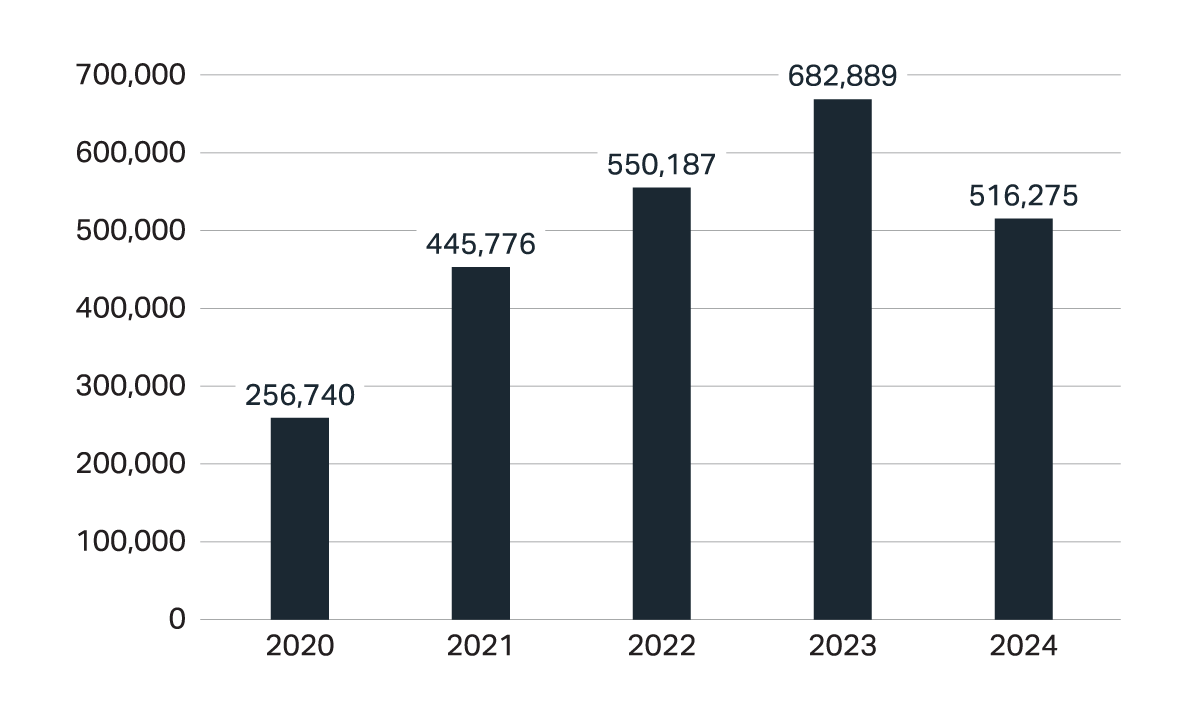
In 2024, 516,275 individuals held study permits in Canada. This included new permits and extensions. Of these, 242,970 identified as women, 273,235 as men, 55 as another gender and the gender of 10 individuals was recorded as unspecified. 

An intake cap on study permit applications was introduced in January 2024 to help manage unsustainable growth in the program, with an issuance target set at 485,000 for that year. Of the 516,275 study permit holders, only 293,835 were issued to new students entering Canada in 2024, with the balance being issued to students already in Canada. 

This means that there were less than 360,000 new study permit holders who entered Canada in 2024.

In 2023, a total of 682,889 individuals held study permits, of which 496,175 were new. This indicates a decrease of 24% from 2023 to 2024. 

Canada’s overall international student population declined by 4% at year end of 2024 compared to end of 2023.


Link to full report


Wednesday, August 06, 2025

Languages Canada Member Schools

About Languages Canada:

In 2007, a joint task force was created. CAPLS and CLC voted to create a new association that would include all public, private, English and French accredited language education program members. A steering committee was formed with equal representation from both associations and a representative from AILIA. In 2008, a set of bylaws and a definitive agreement was approved resulting in the incorporation of the new association, Languages Canada.

Purpose

To be the voice of the Canadian language education sector.

Mission

To promote quality, accredited English and French language education in Canada, both nationally and internationally.

Vision Statement

To be internationally recognized as the symbol of excellence, representing Canada as the number one destination for quality English and French language education.


https://www.languagescanada.ca/en/languages-canada