ESL "English as a Second Language" in Canada education news about English schools, classes, lessons, study-tips, student visas, homestays, travel tips, student jobs, student prices. English test lessons for TOEFL, TOEIC, IELTS, CELPIP, Cambridge CFA CPC CAE FCA, GMAT, GRE, SAT, LSAT, DSAT, CAEL, Cantest, college board, IH, AP, TSE, YLE, BULATS, ILEC, and Michigan exams. ESL English lessons for work, school, jobs, travel, immigration, university admission, graduate studies, career training.

Friday, December 05, 2025

Canada's 2026 International Student Cap By Province

During 2026 the IRCC expects to issue up to 408,000 study permits, including 155,000 to newly arriving international students, as outlined in the 2026–2028 Immigration Levels Plan, and 253,000 extensions for current and returning students. 

As of January 1, 2026, master’s and doctoral level students enrolled at a public designated learning institution (DLI) will not need to submit a provincial or territorial attestation letter (PAL/TAL) with their study permit application. 

This exemption is in recognition of their unique contributions to Canada’s economic growth and innovation, and will support our efforts to attract talent.

The following groups are exempt from the PAL/TAL requirement in 2026:master’s and doctoral degree students enrolled at public DLIs
 
primary and secondary (kindergarten to grade 12) students
certain Government of Canada priority groups and vulnerable cohorts
existing study permit holders applying for an extension at the same DLI and at the same level of study.

The number of study permits expected to be issued in 2026, broken down by student cohort, is as follows:

2026 national target (new arrivals and in-Canada extensions)

Master’s and doctoral students enrolling at public DLIs (PAL/TAL-exempt)

49,000

Primary and secondary school (kindergarten to grade 12) students (PAL/TAL-exempt)

115,000

Other PAL/TAL-exempt study permit applicants

64,000

PAL/TAL-required applicants

180,000

Total

408,000

In 2026, up to 180,000 study permits are expected to be issued to applicants who require a PAL/TAL. The target of 180,000 is distributed to provinces and territories based on their population.

Province or territory

2026 study permit target for PAL/TAL-required cohorts

Alberta

21,582

British Columbia

24,786

Manitoba

6,534

New Brunswick

3,726

Newfoundland and Labrador

2,358

Northwest Territories

198

Nova Scotia

4,680

Nunavut

180

Ontario

70,074

Prince Edward Island

774

Quebec

39,474

Saskatchewan

5,436

Yukon

198

Total

180,000

The following allocations have been assigned based on each jurisdiction’s average study permit application approval rate from 2024 and 2025:

Province or territory

2026 allocations for all PAL/TAL-required applications

Alberta

32,271

British Columbia

32,596

Manitoba

11,196

New Brunswick

8,004

Newfoundland and Labrador

5,507

Northwest Territories

785

Nova Scotia

8,480

NunavutFootnote1

0

Ontario

104,780

Prince Edward Island

1,376

Quebec

93,069

Saskatchewan

11,349

Yukon

257

Total

309,670

A total of 309,670 study permit application spaces will be available under the cap for 2026. This represents the maximum number of study permit applications IRCC will accept for processing from PAL/TAL-required students for the calendar year.

Tuesday, December 02, 2025

2025 Annual Report to Canada's Parliament on Immigration

 IRCC facilitates the entry of students who wish to study at a designated Canadian educational institution. 

Students approved to study in Canada are issued a study permit.

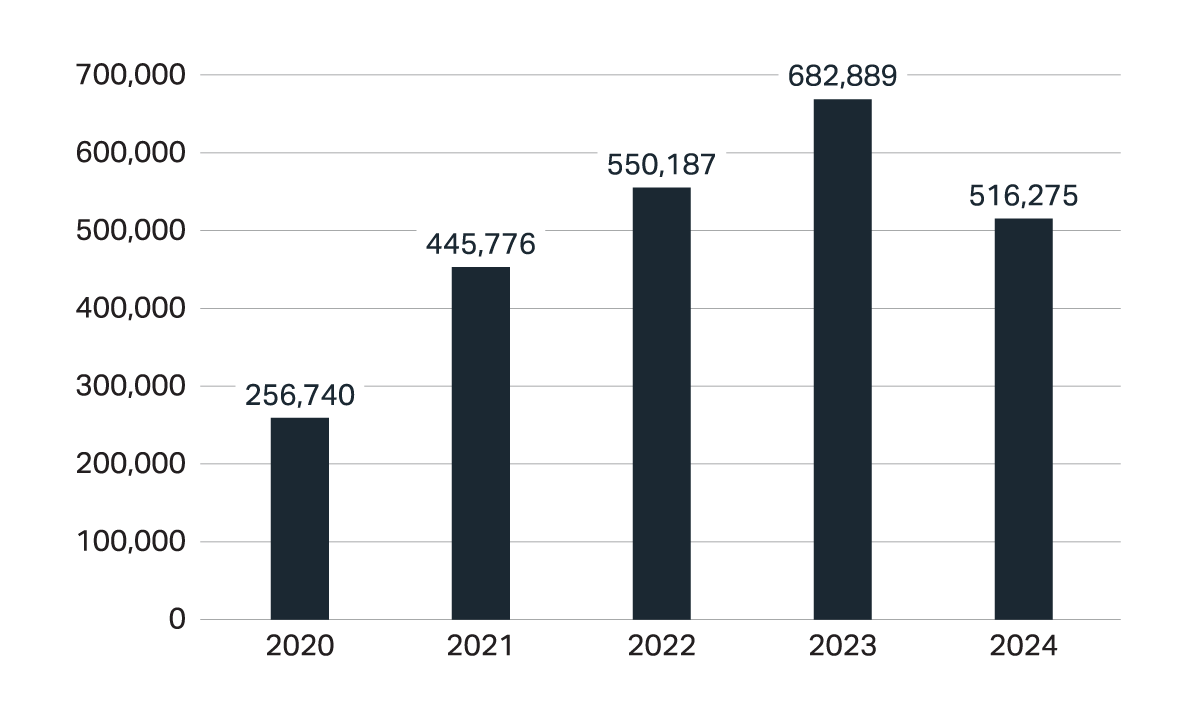
In 2024, 516,275 individuals held study permits in Canada. This included new permits and extensions. Of these, 242,970 identified as women, 273,235 as men, 55 as another gender and the gender of 10 individuals was recorded as unspecified. 

An intake cap on study permit applications was introduced in January 2024 to help manage unsustainable growth in the program, with an issuance target set at 485,000 for that year. Of the 516,275 study permit holders, only 293,835 were issued to new students entering Canada in 2024, with the balance being issued to students already in Canada. 

This means that there were less than 360,000 new study permit holders who entered Canada in 2024.

In 2023, a total of 682,889 individuals held study permits, of which 496,175 were new. This indicates a decrease of 24% from 2023 to 2024. 

Canada’s overall international student population declined by 4% at year end of 2024 compared to end of 2023.


Link to full report


Wednesday, August 06, 2025

Languages Canada Member Schools

About Languages Canada:

In 2007, a joint task force was created. CAPLS and CLC voted to create a new association that would include all public, private, English and French accredited language education program members. A steering committee was formed with equal representation from both associations and a representative from AILIA. In 2008, a set of bylaws and a definitive agreement was approved resulting in the incorporation of the new association, Languages Canada.

Purpose

To be the voice of the Canadian language education sector.

Mission

To promote quality, accredited English and French language education in Canada, both nationally and internationally.

Vision Statement

To be internationally recognized as the symbol of excellence, representing Canada as the number one destination for quality English and French language education.


https://www.languagescanada.ca/en/languages-canada

Thursday, May 15, 2025

Canadian Provinces Manage Education


In BC the Private Training Institutions Regulatory Unit (PTIRU) within the System Integrity Branch (SIB) of the Ministry of Post-Secondary Education and Future Skills administers the Private Training Act and associated regulations. 

Over 60,000 students enroll in private training institutions in B.C. each year. Students are trained for a broad range of occupations from sound and audio technicians to licensed practical nurses to commercial pilots.

The sector is regulated by the Private Training Institutions Regulatory Unit (PTIRU), which is responsible for:

Ensuring institutions meet the requirements and standards for certification
Maintaining a Private Training Institution (PTI) Directory of all certified institutions, along with formerly certified institutions
Providing student protection and overseeing the Student Tuition Protection Fund

Private Training Institutions Regulatory Unit
310-601 Cordova St W
Vancouver BC V6B 1G1
Canada

Local: 604-569-0033
Toll-free: 1-800-661-7441
Fax: 778-945-0606

Email: PTI@gov.bc.ca

Student support inquiries: PTI.StudentSupport@gov.bc.ca

Language Education Excerpts from the Policy Manual

https://www.privatetraininginstitutions.gov.bc.ca/sites/www.privatetraininginstitutions.gov.bc.ca/files/files/policy-manual.pdf#page=8

Examples of programs that do not require approval

 • A career-related program at a registered institution for which tuition is less than $4,000

 • A career-related program at a designated institution for which tuition is less than $1,000

 • A language program at a designated institution that is no more than six months and less than $4,000

 • Any language program at a registered institution

 • A commercial driving instruction program

Programs that require approval 

Programs requiring approval from the registrar fall into three categories: 

Class A: 

Career-related programs with 40 or more hours of instruction, for which tuition is at least $4,000. 

A career-related program is defined as a program that has the purpose of enhancing students’ employability or ability to carry out a career occupation. 

Class B: 

Career-related programs at designated/interim designated institutions, other than Class A programs, for which tuition is at least $1,000. 

Class C: 

Language programs at designated/interim designated institutions that are longer than six months or for which tuition is at least $4,000. A language program is defined as a program that has as its learning objective that students gain or improve proficiency in a language.

Designated Learning Institutions in British Columbia Canada

Tuesday, June 18, 2024

How to use the ENGLISH SIMPLE PAST Tense

SIMPLE PAST

Simple past, form for regular verbs: base+ed

Example; walked, showed, watched, played, smiled, stopped

Simple past for irregular verbs.

Simple past, be, have, do:

Subject  Verb

Be  Have Do 

was  had  did 

You  were had did 

He was  had  did 

We  were had did 

They  were had did 


Affirmative

I was in Canada last year

She had a headache yesterday.

We did our homework last week. 

Negative 

We didn't do our homework last night. 

They weren't in Canada last summer. 

We hadn't any money.

We didn't have time to visit the Eiffel Tower.

We didn't do our exercises this morning.

Interrogative

Were they in Vancouver last January?

Did you have a bicycle when you were a boy?

Did you do much climbing in British Columbia? 


Simple past with regular verbs: verb + ed 

Affirmative 

I washed 

Negative 

I did not wash. 

Interrogative 

Did she arrive? 

Interrogative negative 

Didn't you like? 

Example: to walk, simple past.

Affirmative  Negative  Interrogative 

I walked  I didn't walk  Did I walk? 

You walked  You didn't walk  Did you walk? 

They walked  They didn't walk  Did they walk? 

For the negative and interrogative form of all verbs in the simple past,

 always use the auxiliary 'did''.

Examples: 

Simple past, irregular verbs  'to go'

He went to a gym last night.

interrogative form

Did he go to the club last night?

negative form

He didn't go to bed early last night.

Examples: Simple past, irregular verbs "to give"

We gave her a doll for her birthday.

They didn't give John their copy.

Did Barry give you my report?


Examples: Simple past, irregular verbs "to come"

My parents came to visit me last year.

We didn't come because it was snowing.

Did she come to your open house last week?

Simple past function is used to talk about a completed action in a time before now. Duration is not important. The time of the action can be in the recent past or the distant past. 

Examples:

John Cabot sailed to Canada in 1498. 

My father died last year. 

He lived in Calgary in 1986. 

We crossed Lake Superior yesterday. 

You always use the simple past when you say when something happened, so it is associated with certain past time expressions.

Examples:

Yesterday, I arrived in Montreal.

She finished her work at five o'clock.

We saw a good play last week.

I went to the hockey game last night.

She played the piano when she was a child.

He sent me a report six months ago.

Peter left five minutes ago


Monday, June 03, 2024

English Language Vocabulary for Resumes

Introductions to Resumes

A resume is a tool with one specific purpose

A resume is a sales document designed for a very precise audience.

A resume is a one or two page summary of your education, skills, accomplishments, and experience.

A very good resume is placed in the short list that survives the first cut.

An excellent resume convinces the employer that you have what it takes to be successful in the position or career.

A superb resume motivates the employer to pick up the phone and ask you to come in for an interview.

Types of Resumes

The chronological resume focuses on the experience section of the resume; each job is listed and described in some detail with sections of skills or accomplishments later in the resume.

The functional resume begins with highlights of major skills and accomplishments and focuses attention on what you can do for them.

A combined resume includes elements of both the chronological and functional formats.

Sections of Resumes

The Summary is sometimes labelled as a profile. - This should be four to six lines of text. This section should indicate the position you are looking for, experience and abilities that will be of interest to your next employer.

The Career Summary also called your job history starts with your most recent job and lists backwards in time. Basic career summaries only include the year you started, the year you finished, job title and employer's name.

Career overviews includes job history, brief overview of the companies and responsibilities for each position that you have held.

Achievement differentiates you from anyone else doing your job because what you actually achieved will be a indication of performance.

Education or Academic Qualifications should include recent relevant training.

Personal Details includes your driving licence, languages, volunteer and community groups and interests.

Services for Youth Resources

Your resume is one of the most important tools you have when looking for a job. This page will help you choose the right type of resume for your situation. It will also provide you with tips to help you tailor your resume to the job you are applying for, and to make sure it stands out in a crowd for all the right reasons.

Other helpful resources

CanadaJobs.com Resume Articles

Monster.com Resume Articles

Original Publisher ESL in Canada Directory

Friday, August 18, 2023

Canada's Student Direct Stream Requires IELTS 6 Score

 Some international students can get their study permits faster by using the SDS. IRCC processes most SDS applications within 20 calendar days if the eligibility requirements are met.

Only applications submitted electronically are eligible for SDS processing. All paper applications are processed under the regular study permit application stream and are subject to the associated processing times.

Foreign nationals who are eligible for SDS processing are still subject to all other eligibility and admissibility requirements under the Immigration and Refugee Protection Act (IRPA) and Immigration and Refugee Protection Regulations (IRPR).

Eligibility criteria

The applicant must include the following documents to be eligible for SDS processing:

  1. proof of a valid language test result, completed within 2 years of the date the SDS application was received, showing either of the following:
    • an International English Language Testing System (IELTS) score of 6.0 or higher in each language skill: listening, reading, writing and speaking
    • test évaluation de français (TEF) score that is equivalent to a Canadian Language Benchmarks (CLB) score of at least 7 for each ability
  2. read full requirements here:


Monday, August 07, 2023

English as a Second Language Classes in Windsor Ontario

ENGLISH LANGUAGE PRONUNCIATION CLASS

English language pronunciation includes all the mechanical functions and skills of language sound production and the specific word pronunciation patterns of the English language in context.

The mechanical functions and skills include placement of the lips, tongue, use of teeth, glottis, expanding or contracting the mouth cavity, use of nasal passages and soft palate, vocal folds, controlling the intake and outflow of air, devoicing, breathing and timing.

English language pronunciation class skills and exercises include initial consonant and vowel pronunciation, syllable pronunciation, individual syllable stress patterns, diphthongs and consonant clusters, initial word pronunciation, syllable stress patterns in words, intonation and timing for words, phrases, clauses, complete sentences, expressions and interjections.

English language pronunciation class can take the form of individual drills or group drills by listening and repeating the correct English language pronunciation exercises.

English language pronunciation class can take the form of reading and speaking. Students are expected to read and speak aloud correctly pronouncing each of the words or passages.

Advanced English language pronunciation classes can include accent reduction. Accent reduction can be un-learning in-correct pronunciation and re-learning correct English pronunciation. Accent reduction can also be the initial establishment or correction of pronunciation patterns, speed, timing, stress and intonation.

ENGLISH LANGUAGE GRAMMAR CLASS

English language grammar includes all the technical grammar functions, word placement rules and the "language-art skills" of written language production using English language vocabulary.

English grammar class can include the classification, rules and functions for the eight parts of speech: nouns, pronouns, verbs, adjectives, adverbs, prepositions, conjunctions and interjections.

English grammar class can include the classification, rules and functions for tenses, verbals, conditionals, abbreviations, contractions and punctuation.

English grammar class can include the classification, rules and functions for phrases, clauses and complete sentences.

English grammar class can include the classification, rules and functions for singular or plural, countable or uncountable, male or female or neutral, tangible or intangible, finite or infinite, real or unreal vocabulary words.

English grammar class can include the classification, rules and functions for writing formats, register, audience, level, purpose and style.

English grammar classes can be organized for general English , test-preparation, academic preparation or for working professionals.

ENGLISH LANGUAGE VOCABULARY CLASS


Excellent vocabulary classes will enable the learner brain to make a memory. When you see the word, your brain is making one type of memory. When you hear the word, your brain is making another memory of the target word. When you say the word, you are reforming and reinforcing the memory. Repetition will put the short-term memory of learned words into the longer-term memory. With more brain word networks, repetitions and longer term memories the learner will discover it is easier to always use the word in an expanded and accessible English language vocabulary.

English language vocabulary classes can be designed for the three different levels: beginner, intermediate and advanced students.

English language vocabulary classes can be designed for students studying math, science, music, art, computers and a wider variety of more specific subjects.

Advanced English language vocabulary classes can be designed for professionals such as medicine, engineering, law, diplomacy or international relations.

In excellent vocabulary classes students will hear, see, say and re-use the target words in context .

ENGLISH LANGUAGE WRITING CLASS

English Language writing is defined as: the activity of putting something in written form; the act of creating written works; letters or symbols written or imprinted on a surface to represent the ideas, sounds or words of a language; the work of a writer; anything expressed using the letters of the alphabet in words; and others.

English Language Writing Class can include the mechanical actions, functions and skills for handwriting or electronic data input.

English Language Writing Classes can include all of the English language grammar rules and procedures and specific writing formats, register, audience, level, purpose and style.

English Language Writing Classes can include formal, informal, slang, jargon, expressions, and texting vocabulary.

English Language Writing Classes can be organized for general English writing, writing for test-preparation such as TOEFL TOEIC IELTS or Cambridge tests, academic preparation for undergraduate or graduate programs or working professionals in medicine, law, engineering, science, academics and others.


 English as a Second Language Classes in Windsor Ontario can be online or in-person or at your location. Email: eslincanada@gmail.com

Wednesday, July 26, 2023

Use context to understand meaning in the chaos of English

 Use context to understand meaning in the chaos of English

(context is king)

What is a paradox?

A paradox can be a rhetorical device or can mean a statement that is self-contradictory.

As a rhetorical device, paradox is “a statement or proposition that seems self-contradictory or absurd but in reality expresses a possible truth.” 

For example: My friend is worried because the more she sleeps, the more tired she feels in the morning instead of waking up well rested.  The idea that less is more seems contradictory, but the statement contains a truth.

What is a contradiction? [ kon-truh-dik-shuhn ]  noun

The act of contradicting; gainsaying or opposition: assertion of the contrary or opposite.

A contradiction is a situation or ideas in opposition to one another. Declaring publicly that you are an environmentalist but never recycling anything is an example of a contradiction.

Synonyms for contradiction:

conflict, difference, disagreement, discrepancy, dispute, inconsistency, confutation, contravention, defiance, denial, dissension, incongruity, negation, opposite, opposition, bucking, gainsaying

What is an oxymoron?

An oxymoron is also a noun that’s defined as “a figure of speech by which a seemingly self-contradictory effect, as in ‘cruel kindness’ or  ‘to make haste slowly.'” So when contradictory or opposing words are combined, that expression is an oxymoron. 

Additional examples of this rhetorical device include living death, bittersweet, toughlove.

What is a contronym ? [con·tro·nym]  noun  plural noun: contronyms

A word with two opposite meanings,  

e.g. sanction (which can mean both ‘a penalty for disobeying a law’  and  ‘official permission or approval for an action’).

What is a synonym for contronym?

Frequently described as "words that are their own opposites," contronyms 

(contranym is a variant spelling) are also known as Janus words, antagonyms, and autoantonyms. 

These are words that have developed contradictory meanings.

Contronym Examples:

Finished - Finished can mean completed, or ended or destroyed

All the dishes are washed so I am finished.

After the third knee injury his basketball career was finished.


Bound - Bound can mean “going to a destination” or “being restrained from movement.”

He is bound for pro sports.

The prisoner was bound by his wrists and ankles.


Fast - fast can mean quick, or stuck or made stable

The hummingbird flew very fast between flowers.

The old chewing gum was stuck fast to the sidewalk.


Buckle - Buckle can mean “to fasten or secure” or “to break or collapse.”

I made sure to properly buckle my daughter in her car seat.

The balcony buckled from the weight of too many spectators.


Left - Left can mean “leave” or “remain.”

They had left by lunch time

Expedia claims - only two seats are left.


Off - Off can mean “activated” or “deactivated.”

The alarm went off.

The alarms are off.


Throw out - Throw out can mean “to discard something” or “to offer something.”

I’m going to throw out these old shoes.

I’m going to throw out some ideas for you.


Wind up - Wind up can mean “to bring something to a conclusion or finish” or “to start something.”

Let’s wind up this meeting because it’s getting late.

You need to wind up the toy so it can start.


hypocrite - [ hip-uh-krit ] noun

A person who pretends to have virtues, moral or religious beliefs, principles, etc., that they do not actually possess, especially a person whose actions are opposite of stated beliefs.

A person who feigns some desirable or publicly approved attitude, especially one whose private life, opinions, or statements are opposite of their public statements.


Wednesday, July 12, 2023

How to Study English as a Second Language PLAN

First step " Choose your Goal" for learning English as a Second Language

Goals are your motivation. Goals can remind you of purpose and direction. Why do you need English as a second or third language. What do you wish to accomplish with English as a second language? Studying ESL requires thousands of hours of real effort - you need motivation and endurance to be able to study or work using the English language with native speakers.

Top 15 Goals for studying English as a second language

  • Immigrate into an English speaking country
  • Get hired at a first job
  • Be hired at a better company
  • Be promoted in your company
  • Sell and market your products to English speaking countries
  • Be able to operate a business completely in English.
  • Publish an authoritative business, scientific journal article in English
  • Be admitted and study in a North American university.
  • Be admitted and study in a North American university graduate program.
  • Travel independently in English speaking countries.
  • As an Artist, perform for English speaking audiences
  • Enjoy entertainment produced by English speaking artists
  • Use English instructions for computer applications. Surf the net in English
  • Score 950 on the Toeic test or 280 on the new Toefl exam
  • Study English Literature in the original text

Second step: "Select the best Learning Methods" - how you learn most efficiently

Examples of questions to determine "how you learn best"

  • What English can you learn the most while studying alone?
  • What English can you learn the most by studying in a group?
  • Can you listen once and remember the pronunciation and vocabulary?
  • Does it help to see pictures of nouns or action verbs demonstrated?
  • Do you have to write and repeat words to memorize vocabulary?
  • How many times and ways must you use a word to "know" its proper context?
  • How often do you have to repeat lessons?
  • Can you create and use mnemonics to remember lists
  • Can you benefit using accelerated English language learning methods
  • Does music or games help you to relax, making learning easier?

Third step "Form a Plan" use the best learning stages to reach study Goals

An example of a two year study plan with four stages to learn English:

  • (First stage - 6 months)
    Start with picture dictionaries to begin vocabulary, use the ESL in Canada  or Sentencemaster 1000 most used words list as the initial core vocabulary, start to study pronunciation by watching English TV, listen to taped conversations, for 1 - 2 hours each day.
  • (Second stage - 6 months)
    Add grammar, use the Blueprint for English Grammar Summary for the most important English Grammar points, start to study English punctuation, spelling, vocabulary studies, start to read newspapers/magazines, begin a vocabulary diary to add to your initial 1000 words the for 1 - 2 hours each day
  • (Third stage - 6 months)
    Add one hour of English conversation classes everyday for 6 months, review grammar and vocabulary, add to vocabulary diary each day.
  • (Fourth stage - 6 months)
    Travel to Canada for 400 hours of English conversation classes, perform some volunteer work, take a special interest course and travel using English.
  • (After the Two Year Plan)
    Continuing ESL education program with one English conversation class per week or start your own English Conversation Club, watch English News on TV, read English newspapers do your favourite hobby using English.

Fourth step "create a Cost & Benefit Analysis for your Plan"

  • What FREE English learning resources are available on the internet?
  • What FREE English learning resources are at the library, community or cultural centers?
  • What FREE English Learning clubs offer conversation classes?
  • What FREE English Language exchange clubs offer conversation classes?
  • Compare the costs of books, texts, tapes, Cd's for self-study.
  • Analyze the cost of instruction by tutors in a small group of 3 or 4
  • Analyze the cost of instruction at local English schools
  • Analyze costs of foreign travel and accommodation to study English abroad.

Fifth step "Start your Plan"

Email for help to plan your trip to study "English as a Second Language" ESL in Canada